AI SDRs were supposed to be the end of manual prospecting. Deploy an AI sales agent, point it at your market, and watch the meetings roll in, 24/7, without adding headcount.
In 2026, AI SDR agents are everywhere. Most B2B sales teams now use AI in some part of their prospecting. But many teams that switched on an AI SDR are quietly switching it off again. Tool churn is high, meetings don’t turn into opportunities, and prospects are getting more AI-written emails than ever, many of them wrong.
The problem usually isn’t the AI. It’s the data the AI is working with. In this guide, we explain what an AI SDR actually does, why so many deployments fail, and how verified B2B data turns an AI SDR from a spam machine into a real pipeline engine.
What Is an AI SDR?
An AI SDR (AI sales development representative) is an AI agent that handles the early stages of outbound sales, the work traditionally done by human SDRs. Depending on the tool, an AI SDR can:
- Find target accounts that match your ideal customer profile
- Research companies and decision-makers
- Write personalized emails and LinkedIn messages
- Send and follow up on outreach sequences
- Respond to replies and book meetings
- Update your CRM automatically
This is part of a wider shift to agentic AI in sales: instead of AI that only suggests what to do, AI agents now take actions on their own. They decide who to contact, when, and with what message.
Why AI SDR Adoption Is Exploding in 2026
The appeal is easy to see:
- Scale without headcount. One AI SDR can research and contact far more prospects than a human rep.
- Speed. Account research that used to take hours now takes minutes.
- Always on. AI agents follow up instantly, across time zones.
- Lower cost per touch. Especially for accounts your team would never get to manually.
For sales leaders under pressure to grow pipeline with smaller teams, AI sales agents look like the perfect answer. But adoption has grown much faster than results.
Why Do AI SDRs Fail? The Data Problem Nobody Talks About
An AI SDR is only as good as the data it runs on. When the data is wrong, the AI doesn’t slow down or ask questions. It confidently sends the wrong message to the wrong person, at scale. Here’s where it breaks.
1. Outdated Contacts Mean Bounces at Machine Speed
AI SDRs send far more emails than humans. If your contact data is outdated, that means far more bounces, faster. High bounce rates damage your sender reputation and push even good emails into spam. (See our guide on how to reduce email bounce rate.)
2. Wrong Job Titles Break Personalization
AI personalization depends on facts: the prospect’s role, company, and responsibilities. If the CRM says someone is “Head of Marketing” and they left six months ago, the AI writes a confident, personalized, completely wrong email. To the prospect, that’s worse than a generic one.
3. Dirty CRM Data Confuses the Agent
Duplicate records, missing fields, and inconsistent company names lead AI agents to contact the same person twice, skip good accounts, or misjudge fit. Messy CRMs are one of the most common reasons AI SDR deployments stall. Before switching on any agent, clean your CRM data.
4. No Signals, No Timing
Without buying signals, an AI SDR is just a faster version of batch-and-blast outreach. It can write a nice email, but it can’t know why now is the right moment unless the data tells it.
5. Guessed Emails and Unverified Numbers
Many AI SDR tools guess email formats or pull from unverified sources. Every guess that fails costs deliverability, and every wrong number wastes a call.
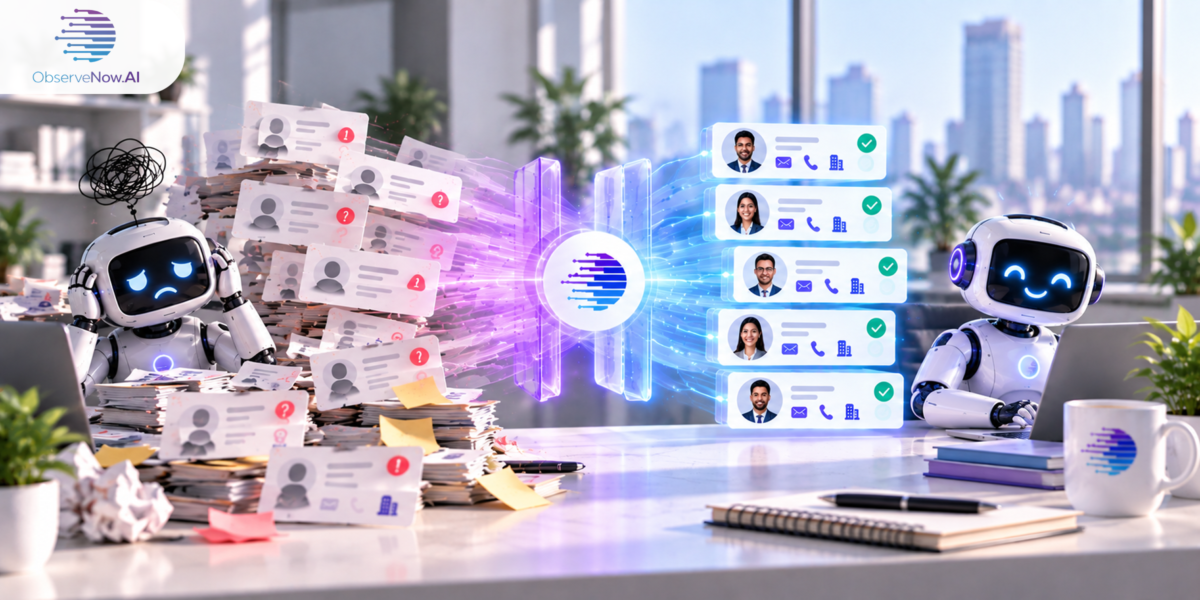
The pattern is clear: AI multiplies whatever you feed it. Clean data gets multiplied into pipeline. Bad data gets multiplied into bounces, spam complaints, and damaged brand reputation.
Signal-Based Selling: What Makes AI SDRs Actually Work
The teams getting real results from AI SDRs have one thing in common: they’ve moved from volume-based outreach to signal-based selling. Instead of emailing everyone on a list, their AI agents act on real triggers:
- A new VP of Sales or CIO joins a target account
- A company raises funding or opens a new office
- A target account starts hiring for roles your product supports
- A former customer or champion moves to a new company
Signal-based outreach consistently gets higher reply rates than static list outreach, because the message is both relevant and timely. But signals only work when they land on accurate records. That’s why real-time prospect intelligence and verified contact data go hand in hand.
AI SDR vs Human SDR: Why the Hybrid Model Wins
Is AI replacing SDRs? For most teams, the answer in 2026 is no. It’s changing what SDRs do.
| AI SDR | Human SDR | |
| Best at | Research, volume, speed, follow-ups | Relationships, judgment, complex deals |
| Works well on | Long-tail accounts, early-stage outreach | Strategic and named accounts |
| Weakness | Bad data, nuance, trust | Time and capacity |
The strongest setup is a hybrid SDR model: AI agents handle research and first-touch outreach on lower-priority accounts, and human reps focus on high-value accounts and take over conversations once a prospect engages.
How to Make Your AI SDR Work: A 5-Step Checklist
- Clean your CRM first. Remove duplicates, fix formats, and archive dead records before connecting any agent.
- Verify every contact. Only let the AI send to verified work emails and phone numbers.
- Enrich missing data. Give the AI complete profiles (role, seniority, company size, industry) so it can personalize accurately. Start with B2B data enrichment.
- Feed it signals, not just lists. Trigger outreach on job changes, growth, and hiring activity.
- Keep humans in the loop. Review messaging, monitor bounce and reply rates, and hand engaged prospects to human reps quickly.
The Best Data for AI Sales Agents
Whether you use an AI SDR tool, an AI assistant, or build your own agents, the data layer decides the results. Look for data that is:
- Verified: work emails and direct phone numbers checked before use
- Current: updated as people change jobs and companies change
- Complete: enriched with role, seniority, and company details
- Compliant: sourced in line with data-protection laws such as GDPR and India’s DPDP Act
- Connected: easy to plug into your CRM and AI tools
How ObserveNow.ai Powers Smarter AI SDRs
ObserveNow.ai is a B2B data enrichment platform that gives your AI SDR the foundation it needs: accurate, verified contact data.
With ObserveNow.ai, you can:
- Feed your AI agents verified work emails and direct phone numbers from 400M+ global B2B contacts
- Clean and enrich your CRM before automation starts
- Keep records current so AI personalization is based on real, up-to-date roles
- Reduce bounce rates and protect your sender reputation as outreach scales
- Help AI and human reps focus on the decision-makers most likely to convert
Your AI SDR is only as smart as its data. Give it the right data.
Power your AI SDR with verified data from ObserveNow.ai →
Conclusion: AI Doesn’t Fix Bad Data. It Scales It.
AI SDR agents are here to stay, and they will keep getting better. But the teams winning with AI sales agents in 2026 aren’t the ones with the flashiest tools. They’re the ones with the cleanest data, the sharpest signals, and a smart hybrid model that combines AI scale with human judgment.
Before you buy another AI SDR tool, fix the data it will run on. That’s what decides whether your AI builds pipeline or burns it.